
Fixed Wireless Access: America's Quiet Internet Revolution

Picture this: you're sitting in a farmhouse in rural Nebraska, streaming a 4K movie while your kids attend virtual classes and you join a video conference for work. Just five years ago, this scenario would have been impossible in most of rural America. Today, thanks to Fixed Wireless Access technology, millions of Americans are experiencing internet speeds that rival what you'd find in downtown Manhattan.
Fixed Wireless Access—let's call it FWA for short, though I'll explain every technical term as we go—has quietly become one of the most transformative technologies in American telecommunications. It's bridging the digital divide, challenging cable monopolies, and fundamentally changing how we think about internet delivery.
What Exactly Is Fixed Wireless Access?
Fixed Wireless Access is a modern blend of reliable home internet and the convenience of wireless technology. Unlike mobile service, which moves with you, Fixed Wireless Access delivers fast, stable internet to a specific location—your home or business—using radio waves instead of underground cables.
Here’s how it works: a telecommunications provider installs a base station on a nearby tower, usually within coverage of your location. At your home, a device known as Customer Premises Equipment (CPE) receives the wireless signal and turns it into the Wi-Fi or wired internet connection your devices use every day. This CPE combines a specialized antenna, a radio transceiver, and a router into a single unit.
The real advantage comes from how the radio spectrum is used. Early Fixed Wireless Access systems depended on lower-frequency bands that could cover long distances but didn’t offer much data capacity. Today’s advanced systems use a mix of spectrum layers:
Low-band frequencies (below 1 GHz): Great for covering wide areas and reaching distant locations.
Mid-band spectrum (3–7 GHz): Strikes a balance between range and capacity, making it ideal for most communities.
Millimeter wave (above 24 GHz): Delivers ultra-fast speeds in dense, high-demand areas, like city centers.
By layering these frequencies, providers can tailor their networks to different environments—using mid-band for broad rural coverage and adding millimeter wave hotspots in cities for extra capacity where it’s needed most.
The Radio Access Network (RAN) supporting these services has evolved dramatically. Massive Multiple Input Multiple Output (MIMO) antenna arrays can focus radio energy with surgical precision, while advanced beamforming technology ensures signals reach exactly where they're needed. These innovations allow a single cell tower to serve hundreds of Fixed Wireless Access customers simultaneously while maintaining the network capacity for traditional mobile users.
Real-World Performance and Capabilities
The performance of modern Fixed Wireless Access can genuinely surprise people accustomed to thinking of wireless as inherently slower than wired connections. Well-designed 5G Fixed Wireless Access networks routinely deliver speeds exceeding 100 megabits per second (Mbps), with many customers experiencing 300-500 Mbps or higher. In optimal conditions with millimeter Wave technology, speeds can reach multiple gigabits per second—rivaling the fastest fiber connections. Think outdoor stadiums, venues and dense urban. Also, think rural areas that are getting for the first time 100 Mbps speeds (Blazing fast from rural view)!!!
Overcoming Traditional Wireless Limitations
Every technology has constraints, and Fixed Wireless Access is no exception. Weather conditions can impact performance, particularly during heavy rain or snow when radio signals experience attenuation and line of sight conditions particularly on mmwave and hence are not too suitable for deep indoor. Guide rule is to have a window mount and roof mount as required for clear line of sight. Signal interference from other electronic devices, neighboring wireless networks, or even atmospheric conditions can occasionally cause performance fluctuations. The Customer Premises Equipment includes sophisticated filtering and signal processing to minimize these effects, but optimal installation and positioning remain important for consistent performance.
Network capacity management presents perhaps the most significant operational challenge. Fixed Wireless Access customers typically consume far more data than traditional mobile users—often 10-20 times more monthly data usage and may not pay more than home WI-FI service. This requires careful network planning and ongoing capacity upgrades to ensure service quality remains high as subscriber numbers grow.
Rural America's Digital Transformation
Perhaps nowhere is the impact of Fixed Wireless Access more profound than in rural America. Communities that waited decades for reliable broadband have suddenly gained access to internet speeds that exceed what many urban areas enjoyed just a few years ago. This transformation enables everything from remote work and online education to telemedicine and precision agriculture.
The deployment speed advantage of Fixed Wireless Access becomes particularly apparent in rural areas. While fiber installation might require months or years of planning, permitting, and construction, Fixed Wireless Access can often be activated within days of a coverage area being lit up. This rapid deployment capability has made it an attractive option for addressing the digital divide that has long separated rural and urban America.
Business and Enterprise Applications
Fixed Wireless Access isn't limited to residential applications. Businesses across various industries are discovering its advantages for everything from primary internet connectivity to backup and redundancy solutions. Construction sites, temporary facilities, and remote locations can be connected quickly without the delays and costs associated with traditional wired installation.
Enterprise-grade Fixed Wireless Access services often include features like static Internet Protocol (IP) addresses, enhanced Service Level Agreements (SLAs), and priority traffic handling. These capabilities make wireless broadband a viable option for businesses that previously required expensive dedicated circuits or T1 lines.
Market Growth and Leadership
T-Mobile leads FWA market with 6.43 million subscribers, followed by Verizon with 4.3 million
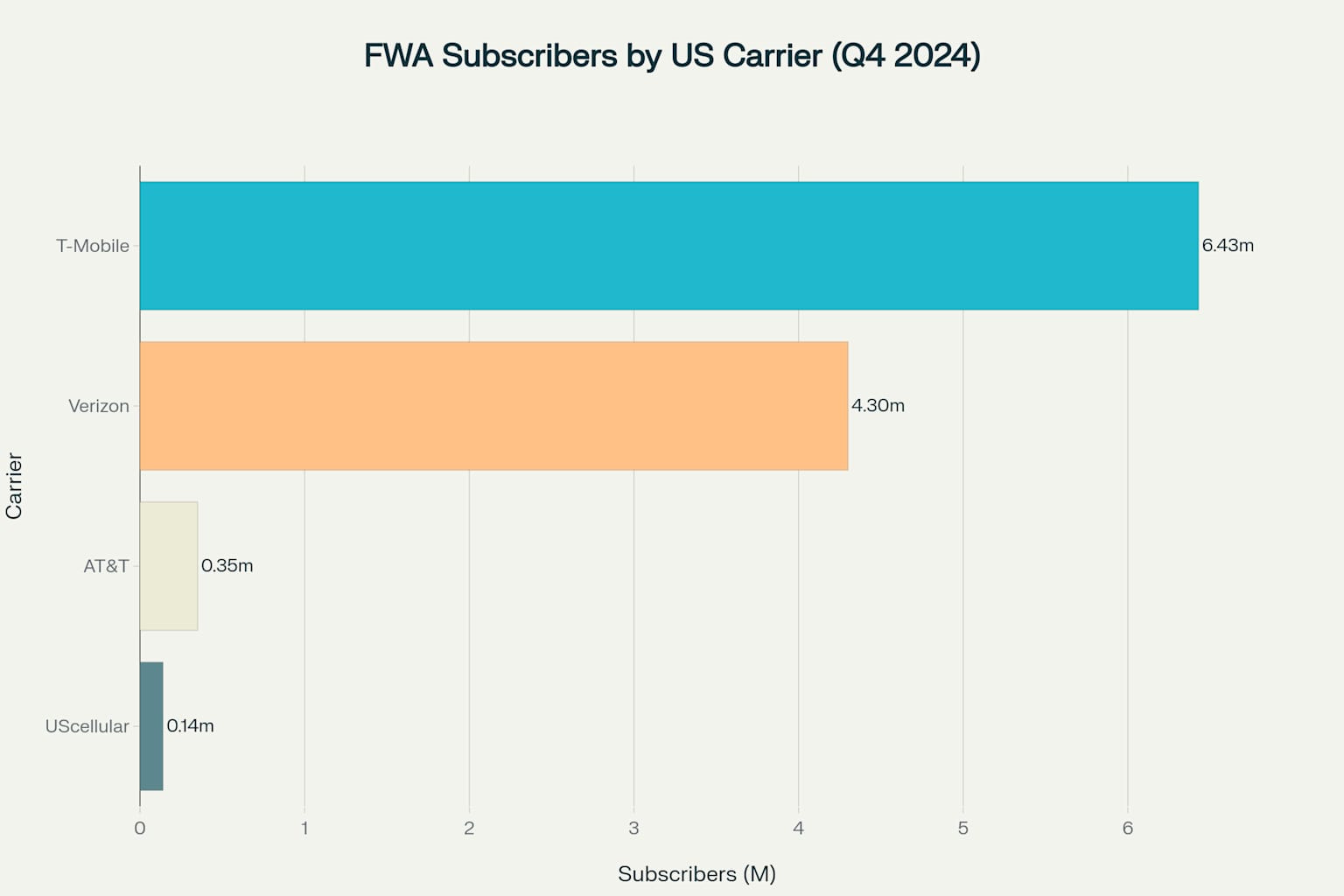
These subscriber numbers represent a combined market of over 11.5 million households.
Performance and User Experience
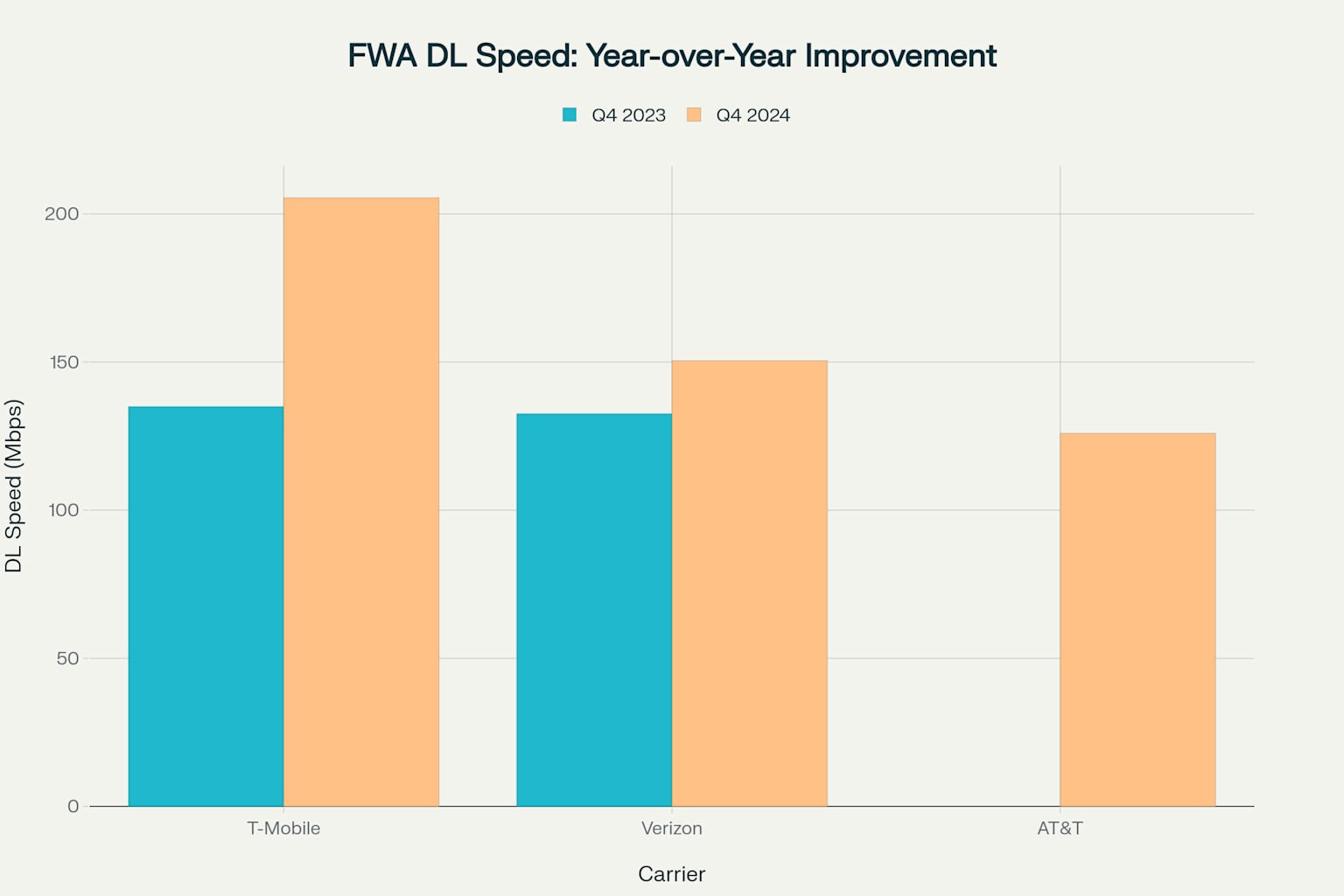
T-Mobile FWA speeds increased 52% year-over-year, from 135 Mbps to 205 Mbps
Economic Advantage: FWA vs. Fiber
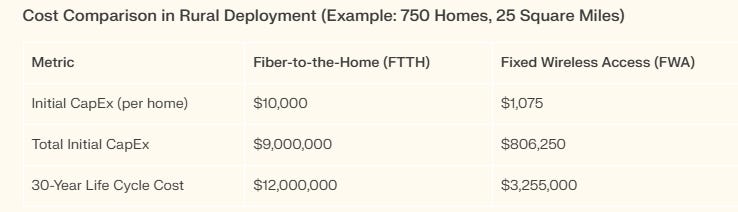
FWA deployment costs are under 10% of FTTH in rural settings, and total cost of ownership is only 27% of fiber over 30 years.
FWA enables rapid, affordable broadband expansion in areas where fiber is economically unfeasible.
National and Global Reach
As of June 2025, 567 operators in 188 countries have announced FWA services; 495 operators in 176 countries have launched commercial offerings.
In the U.S., private-sector investment and competitive deployment strategies have driven FWA adoption, maintaining America’s leadership in wireless broadband innovation.
Challenges and Considerations
Peak-Hour Performance: Some users experience slower speeds during peak times, but ongoing network investments are addressing these issues.
Sustainability: Concerns persist about the long-term upgrade cycle for FWA equipment, especially in areas funded by the Rural Digital Opportunity Fund (RDOF), where buildout timelines and technology refreshes are critical.
Coverage Gaps: RDOF awards have sometimes resulted in fragmented service areas, complicating coherent network planning for both FWA and fiber providers.
Future Outlook
FWA is projected to capture an increasing share of new broadband connections, with continued double-digit growth through 2030.
Advances in 5G, antenna technology, and spectrum management will further boost speeds, reliability, and coverage.
Government funding (e.g., RDOF, BEAD) and private investment are accelerating FWA’s expansion into both rural and suburban markets.
Personal Tiger’s take: FWA is a great technology offering green shoots and revenue for telecom operators, now with BEAD (42.5 billion funding) rules being rewritten that favor the most cost-effective solution as opposed to fiber -that was preferred earlier. But FWA does come with its own issues such as milli meter wave spectrum having non line of sight coverage issues and consumers consuming a lot like 15x more than mobile data but lol not paying 15x more than mobile. But no matter what, FWA is another solution that will connect the over connected Urban people (think less expensive than fiber) and connect the under connected Rural folks (think 3 digits download speeds).
I can be reached at abhishek@personaltigerllc.com
Sources:
1 Precedence Research
3 Ookla
4 Inside Towers
6 Benton Institute
5 GSA
2 Market.us